13th December 2025 - All-day Meeting: New Acquisitions & Queries
- Nick Colley

- Jan 16
- 6 min read
This has become our annual Banstead all-day meeting with new acquisitions and queries - and a chat over tea/coffee, biscuits and mince pies with members displays as well! We had a total of 14 members and 1 guest present, with Frank Schofield and his daughter having a table with books on the Royal Navy for sale and Phil Kaye selling postal history covers. Peter High also had a small number of publications for sale.
First to display was our President, Geoff Hanney, with latest acquisitions in the form of a correspondence all postcards from a sailor cancelled using dumb circular and Krag machine cancellers from Scrapa Flow. All had been censored on HMS Imperieuse between 1915 and 1916. He also showed a few postcards from army camps in the UK plus couple of copies of the Tom Tom newspapers issued by the UN forces in the Congo in the early 1960's and a Balkan News from Salonica in WW1.
Second to display was Frank Schofield with a selection of WW1 covers and postcards with rare ‘L’ numbered APOs from L14 (Fiume), L15 (Venice) and L16 (Belgrade). It’s not often that you see these but Frank has built up a good collection of such material.
Third to show was Chris Clothier with a selection of modern BFPS commemorative datestamps and covers relating to Royal Engineers events such as the Diamond Jubilee of the Royal Engineers Association (REA) which was founded in 1912 under the name of the Royal Engineers Old Comrades Association; 95th Anniversary of Rorke’s Drift during the Zulu War 1879 which was defended by 150 troops under the command of Lieutenant John Chard RE and a Lieutenant from the 24th Regiment of Foot; 30th Anniversary of the crossing the Rhine in 1945 and the 50th Anniversary of the Army Apprentices College Chepstow which originally opened as a Boy’s Technical School, recruits joined as apprentice tradesmen at the age of 14 or 15 and spent up to 4 years at the school. His second showing was a small selection of covers and datestamps relating to events leading to the 200th Anniversary of the Granting of the Royal Warrant to what became the Corps of Royal Engineers. Examples of these included a cover showing a Royal Engineers Officer & Royal Military Artificers from 1787 with, in the background, work being conducted on a Martello Tower and a 1987 cover with Falkland Islands stamps marking the 200th Anniversary.
Malcolm Cole gave a display entitled "Life in the Trenches". The display highlighted the awful conditions that soldiers from all countries endured during the Great War, the smell of death and detritus, freezing weather conditions, the effects of gas attacks, the swarms of rats etc. On a lighter note, the display showed a number of postcards drawn by Bruce Bairnsfather and Fergus Mackain showing the more humorous aspects of daily life in the trenches. The display ended with a "tobacco" card sent by Private Robert Tanner stating that he was in excellent health. Shortly afterwards, he was shot in the groin and shipped back to Brighton for treatment. Following 88 days of treatment and further recuperation he was returned to the front where, five weeks later, he received a shrapnel wound to the face and lost most of his teeth!


Peter Burrows displayed part of his collection of Royal Air Force Christmas Cards and Menus. He explained that it was not always possible to date them. He started with a post card for 216 Squadron in Egypt in 1926; then followed cards etc from units serving in Australia, Azores, BLA, Canada, Ceylon, Hong Kong, India, Iraq, Italy, MEF, New Zealand, North Africa, West Africa, and South Africa. There was also one from the Women’s Auxiliary Air Force (WAAF), Coastal Command and a Polish Squadron. The display finished with card from BAOR in 1945.

Peter High was the first to show in the second displays. His was a mix of subjects, all new to his collection. We saw a cover from HMS Acorn from Shanghai 1861. Acorn had been a former anti-slave brig, but the cover was from her as a hospital ship towards the end of her service. Another interesting item displayed was a cover that had been salvaged from an air crash in Benghazi, Libya, September 1936, during the Italo-Ethiopian War. The aircraft, a seaplane, had been carrying mails from the troops invading Ethiopia. This was followed by two covers from the former Italian hospital ship Gradisca, after she was seized by Germany after the Italian surrender, both with Kriegsmarine Feldpost numbered cachets. One of the covers is illustrated below.

Michael Dobbs displayed a number of recent acquisitions starting with an RAF Message Form with a telegram to an aircraftsman at RAF Bicester from his mother in 1941; a number of covers addressed to 200 Provost Company RMP in Singapore and cancelled with LONDON BAPO datestamps 13 to 17 in 1961-62; red bag labels from BFPO Dusseldorf to various locations in Germany with printing dates of 1982 & 1985; two normal bag labels to BFPO 637 (Al Jubayl, Saudi Arabia during Op Granby); various registered mail with BAOR numbers and also larger WW2 labels with FPO datestamps; various NATO-related covers including two from SHAPE with CFPO 5048 & US APO 09055 datestamps commemorating 20 years in Belgium and four commemorative covers with various national datestamps and meter marks issued for AFCENT STAMPEX 6-8 February 1987. The red bag labels raised the question why red? Geoff Hanney suggested they were handed to the Bundespost for delivery (there were German words Von, Nach and Uber on the labels) using red so not to cause confusion with other bags of mail to the UK, etc. The next question - has anyone got any information on AFCENT Stampex? This query will appear in our Spring 2026 Journal.


Nick Colley showed a handful of WW2 naval items - except one which was an Air Raid Casualty Notification card. These were clearly intended for use by ‘the authorities’ to notify serving personnel that someone close to them (friend, relative) had been ‘Killed, Dangerously/Seriously/Slightly Wounded’ (delete those inapplicable). This example had not been used, but the distress that would have been caused upon receipt of such a card can only be imagined (Figures NC1 and NC2). Another notable item was the cover of a hand-delivered message from the battleship HMS King George V (KGV) to the American battleship USS Washington. It carries the instruction to acknowledge receipt (Figure NC3) (an early form of ‘read-receipt’, perhaps? :-) ). Nick had investigated how a British vessel could issue such an apparently formal communication to a US vessel. His research led him to the (British) naval situation prevailing in April 1942, when the Home Fleet had been depleted as ships had been transferred away for Operation Ironclad, the liberation of Madagascar from the Vichy French. The US had lent a number of vessels (including USS Washington) to bolster the Home Fleet in its operations to cover the Russian convoys. The C-in-C Home Fleet had his flag in the KGV, and the American vessels, including the Washington, were subordinate to him. A third item of note was a registered item from the Admiralty (with
Admiralty registration label), dated in May 1943 (Figure NC4). It is addressed to S. Rous CBE. At the time, Stanley Rous was the secretary of the Football Association, and was awarded the CBE in 1943. He was knighted in 1949, and went on to become the sixth President of FIFA.


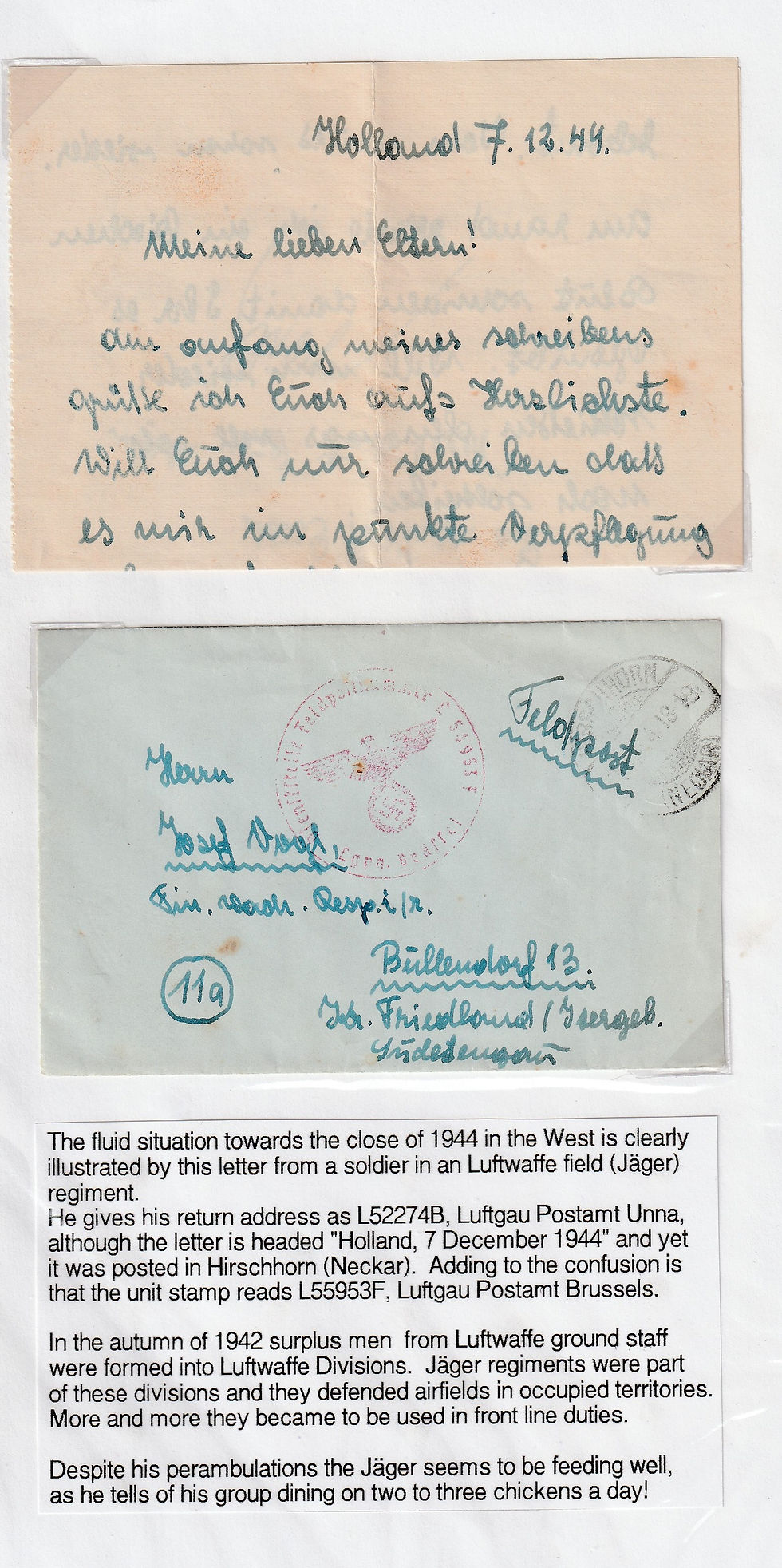
Simon McArthur presented 10 sheets of late World War 2 German Feldpost. By this time the Feldpost was becoming unreliable so soldiers sometimes used the normal postal system instead, using normal postal rates. One item on display originated in Holland but the return address was in Unna, Germany and it was posted in Hirschhorn also in the Reich. Confusingly the Feldpost unit stamp is located in Brussels, Belgium. Sometimes Feldpost mail was given to a colleague returning on leave to post within Germany through the Reichspost system which would not charge for the service. The contents of the accompanying letters reflected the period 1944-45 with concern over bombings and food shortages.